Lire l'article


Vous avez du mal à exprimer vos idées en réunion ou à dire non à un collègue sans vous sentir coupable ? L’assertivité, un concept introduit dans les années 1950 par le psychologue Andrew Salter et développé par Joseph Wolpe, permet de communiquer de façon directe et respectueuse, sans verser dans la passivité ni l’agressivité. Dans cet article, nous vous présentons des techniques concrètes pour renforcer cette compétence et améliorer vos relations professionnelles.
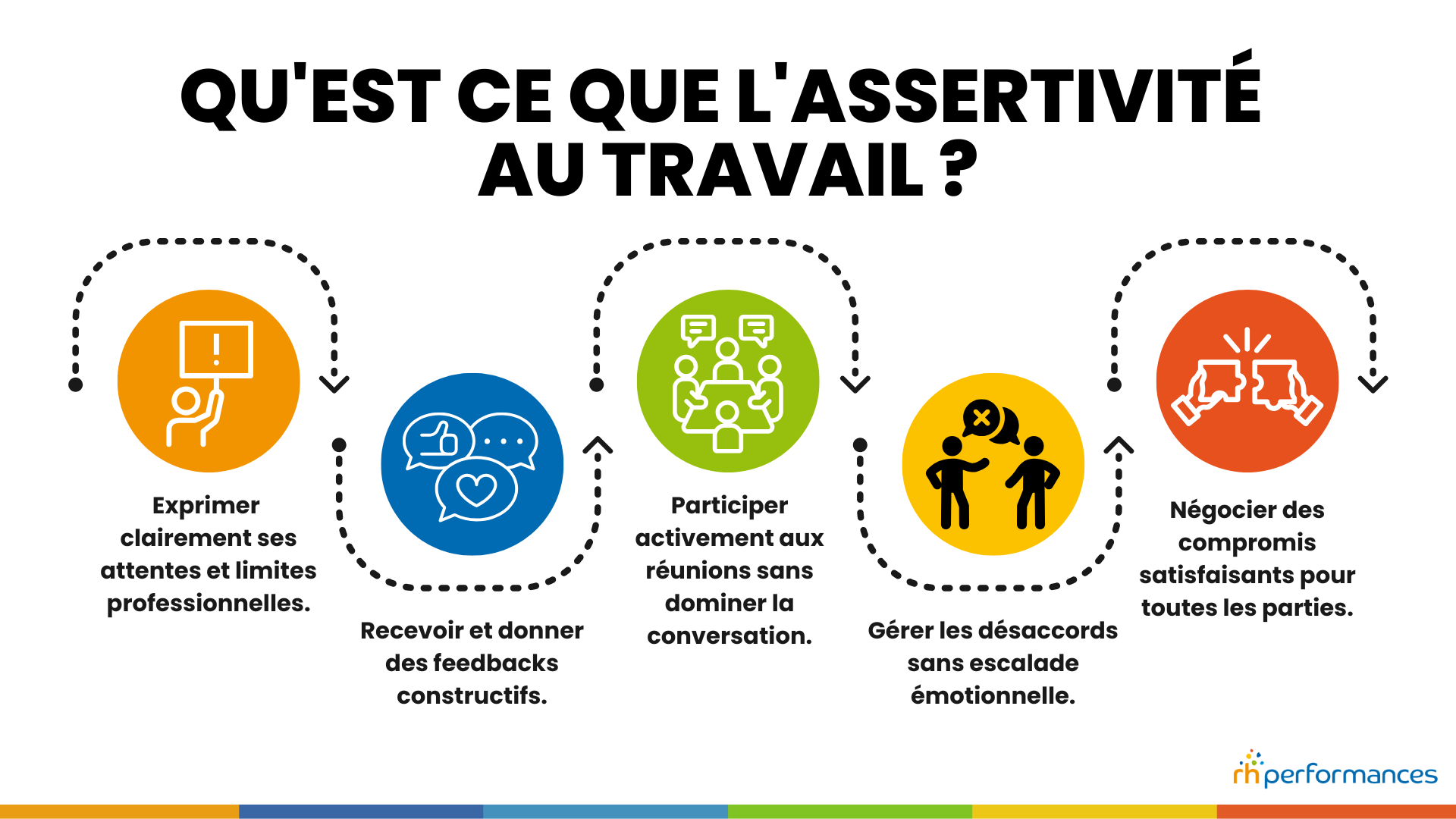
Assertiveness, an essential skill in the professional world
Assertiveness is the ability to assert yourself in various situations, to express your thoughts clearly, your needs, your feelings and your limits, while respecting those of others. It's a key skill in personal development and a soft skill sought after in many jobs and professional roles.
Contrary to what one might think, being assertive doesn't mean being either submissive or aggressive. It's about adopting an assertive posture that's balanced: asserting yourself at work your ideas and your rights in a respectful manner, without imposing or suffering. In a company, this posture promotes open communication, solid professional relationships, and a positive work environment.
To fully understand assertiveness in daily life, you need to distinguish it from three other attitudes often encountered in the professional environment:
In contrast to these behaviors, assertive attitude allows establishing mutual respect, improving communication, and working effectively, even in difficult situations.
In a demanding professional context, developing your assertiveness allows you to:
These benefits of assertiveness often translate into better productivity, employee recognition, better stress management, and increased employee engagement.
An assertive employee:
These qualities are valued in many job postings, and can make a difference during a promotion, change of position, or in the exercise of a manager role. By the way, an assertive manager contributes to creating a culture of effective communication, mutual respect, and lasting cooperation.
Assertiveness is a skill that can be developed, as shown by work in behavioral therapy since the mid-twentieth century. Here are some practical techniques and tips to adopt:
Developing your assertiveness is about adopting assertive behavior that serves both the individual and the collective. In a constantly evolving work world, it's a form of intelligence that makes you useful, adaptable, and more effective. This reflects clear thinking, structured, capable of guiding decisions and fostering healthy relationships.
To go further, we can draw inspiration from the work of Salovey and Mayer, founders of the concept of emotional intelligence, or practical works like those bearing the ISBN 978…, often cited in resources related to personal development and assertive communication.
Asserting yourself with respect is a powerful lever for success in business and a pillar of a more human professional world.
Assertiveness concretely transforms your professional daily life. It acts on several aspects of your work life, with positive effects that reinforce each other.
Smoother communication and more peaceful relationships
When you communicate assertively, your exchanges become clearer. You express your ideas straightforwardly while remaining respectful. Result: fewer misunderstandings, less tension. Your colleagues know what to expect from you. This transparency creates a climate of trust that facilitates collaboration.
Better management of your stress
Assertiveness helps you set boundaries without guilt. You learn to say no when necessary, which prevents work overload. You also express your needs more easily. This ability to assert yourself greatly reduces your daily stress level.
Six concrete benefits at work
Assertiveness brings practical benefits:
An impact on your overall well-being
These changes create a virtuous cycle. You feel more comfortable in your interactions. Your self-confidence grows. Your job satisfaction increases. And this positive energy is transmitted to your team, contributing to a healthier work environment for everyone.
But how do you move from theory to practice and truly integrate assertiveness into your daily professional life? A few simple methods and practical advice can help you progress step by step.
Developing your assertiveness is first and foremost practicing concrete techniques that you can apply starting tomorrow at the office. This involves learning to say "I think that" rather than "you're wrong", knowing how to set boundaries without guilt, or managing your emotions when tension rises. The goal? Transform tense situations into constructive exchanges where everyone can express themselves peacefully.
Assertiveness develops through practice, not just theory. Here are concrete exercises to test in your next meeting.
Exercise 1: The "I" technique Replace your accusations with personal observations. Instead of "You never listen to me", say "I notice that my ideas are not being taken into account". This approach avoids defensiveness and opens dialogue.
Exercise 2: The OSBD method for expressing a problem Structure your difficult messages: Observation (the facts), Sentiment (your feeling), Need (what you lack), Demand (your concrete proposal). For example: "I notice that deadlines are not being met (O). This stresses me (S) because I need predictability (N). Can we set realistic deadlines together? (D)"
Exercise 3: Active listening in three steps Rephrase what your interlocutor is saying ("If I understand correctly..."), ask open questions ("What concerns you most?"), and encourage expression ("I see this is important to you").
These exercises transform tensions into constructive exchanges. Start with one, master it, then gradually add the others.
Workplace conflicts become dialogue opportunities when you master assertiveness and non-violent communication. These two approaches complement each other perfectly to transform tensions into constructive exchanges.
Active listening, your first asset
Before reacting, listen truly. Active listening promotes better mutual understanding and strengthens assertiveness. Rephrase what your interlocutor is saying: "If I understand correctly, you think that..." This simple technique shows that you take their concerns seriously. You validate their emotions without necessarily agreeing with their arguments.
The D.E.S.C. method to structure your exchanges
Assertiveness combined with the D.E.S.C. method is effective for transforming conflicts into productive dialogues. This four-step approach guides you:
Non-violent communication in practice
This method follows four simple steps. First, observe without interpreting: describe what happened, period. Next, express what you feel without accusing the other. Then identify your needs behind this emotion. Finally, make a clear and specific request.
For example: "When you interrupt my presentations (observation), I feel destabilized (feeling) because I need to finish my ideas (need). Could you note your questions and ask them at the end? (request)"
A few golden rules to remember
Handle conflicts in private, not in front of the whole team. Choose the right moment: avoid difficult end-of-day times or periods of intense stress. Stay on one topic at a time. And above all, keep your goal in mind: solve the problem, not be right.
These techniques require practice. Start with the least tense situations to train. Over time, you'll manage even the most delicate conflicts with serenity.


pour ne louper aucune de nos actus