


Lire l'article


Wondering if your company's absenteeism rate is within the norm or how to reduce it? In France, absenteeism costs businesses over 120 billion euros per year, an amount often underestimated by leaders. In this article, you'll discover how to precisely calculate this rate, the most recent benchmark figures, and concrete levers to control it.
The absenteeism rate measures the proportion of unscheduled absences relative to theoretical working time. It's a key indicator for assessing the social health of your company.
The Basic Formula
The calculation is fairly simple:
(Number of hours or days of absence / Number of theoretical hours or days worked) × 100
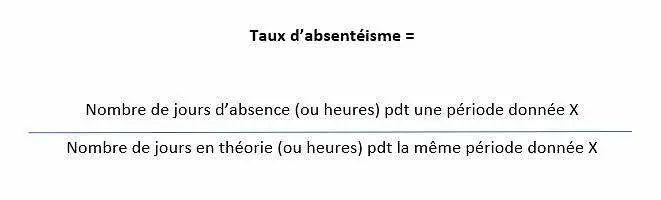
You can use hours or days depending on what works best for you. Hours often give a more precise view, especially if you have part-time employees.
Which Absence Periods Should Be Counted?
Not all absences are equal. Here's what to include in your calculation:
And what to exclude:
The idea? Only count unpredictable absences that actually disrupt the organization.
A Concrete Example
Take a company of 20 employees working 8 hours per day. Over a month of 22 working days, you had 40 total days of absence.
This rate gives you an objective basis for analyzing the situation and making decisions. You can calculate it monthly, quarterly, or annually depending on your needs.
But to know whether this figure is concerning or within the norm, it's essential to compare it to national and sector-specific data. A look at recent statistics helps position your organization within the current landscape of absenteeism in France.
In France, the average absenteeism rate hovers around 4.5 to 5% per year, but this average hides very different realities depending on sectors and regions. The public sector shows higher rates than the private sector, while large companies with over 1,000 employees generally experience higher absence levels than SMBs. These disparities are explained by various factors: working conditions, average staff age, HR policies, or regional specificities that directly influence absence behaviors.
An absenteeism rate below 5% is generally considered acceptable in most French companies, although this benchmark remains indicative. Indeed, the notion of normality depends on many factors: working conditions, given period, employee category, nature of sick leave (illness, workplace accident, family reasons), average duration of absences, or the salary cost associated with salary maintenance and replacement.
Between 5% and 8%, you enter an alert zone: the indicator may reveal health problems, a fragile social climate, increased stress, organizational dysfunctions, or a drop in motivation. Beyond 8%, the rate becomes concerning: it directly impacts productivity, leads to rising costs, affects quality of work life (QWL), and can weigh on human resources management, recruitment, planning, payroll, or even client relationships.
But beware: these thresholds don't apply uniformly. Each company must consider its own situation, sector (e.g., 2024 absenteeism rate in the private sector or public service), work environment, types of absences (short-term, long-term, repeated absences), and causes: mental health, work organization, commute, management, engagement, company culture, workload or exposed positions, etc.
The essential thing is therefore to define your own benchmark. To do this, analyze your historical data, your absence days, your planned work hours, the total number of employees, and compare yourself to similar companies. Don't forget: you must exclude planned absences (leave, training), as they completely distort the rate calculation and the analysis of the phenomenon.
In practice, rather than looking for a magic number, focus on:
That's where the warning signs are: a sudden increase, a productivity drop, a high number of sick leaves, the highest absenteeism in a specific team, or an impact on the social climate.
Identifying these variations allows you to measure, analyze, and prevent absenteeism, reduce direct and indirect costs, and sustainably improve quality of work life within your organization.
In the public sector for example, local authorities show a rate of 5.17% in 2023, while the National Education system averages around 6.7 days of absence per employee per year.
These gaps are explained by very different field realities. Physical jobs generate more workplace accidents, female-dominated sectors have higher rates, and large public structures often offer better social protections.
To establish your benchmark, look at the averages for your industry. A 3% rate can be concerning in consulting, but normal in construction. The important thing is to compare like with like.
Also keep in mind that 27% of employees are absent at least once a year. That's the reality of today's working world. Your benchmark should therefore incorporate this data rather than aiming for zero absenteeism, which remains unrealistic.
Workplace absenteeism has multiple and often interconnected origins. Understanding these causes allows companies to better target their prevention actions.
Common illnesses represent the leading cause of absence, accounting for 54% of cases. Colds, flu, gastroenteritis... these everyday ailments affect everyone and explain a large portion of short-term sick leave. This is normal and inevitable to a certain extent.
Musculoskeletal disorders come in second. Back pain, tendinitis, joint pain... These problems are often linked to working conditions: awkward postures, repetitive movements, heavy lifting. They particularly affect certain sectors like construction or manufacturing.
Psychosocial risks constitute a major cause, representing between 22 and 36% of absences depending on studies. Chronic stress, burnout, workplace conflicts, or lack of recognition can push employees to be absent. These situations are all the more concerning as they tend to worsen over time.
Difficult working conditions also play an important role. Excessive workload, atypical schedules, noisy environments, or inadequate equipment create favorable conditions for absenteeism. Older employees are particularly sensitive to these factors, especially when their position isn't adapted to their physical evolution.
Finally, personal life constraints also influence absences. Childcare difficulties, excessively long commute times, family problems... These factors external to work can sometimes lead to repeated absences.
Each company has its own absenteeism profile. Causes vary enormously depending on the industry, the organization's size, employee age, or work organization. That's why a personalized assessment remains essential to identify the most relevant action levers.
But beyond identifying causes, it's essential to concretely measure the consequences of absenteeism on the organization's life. Because each absence, whatever the reason, has very real repercussions on the organization and its economic balance.
Workplace absenteeism is costly for French organizations. Very costly indeed: over 120 billion euros per year, a 2024 absenteeism rate that confirms a concerning national trend in both the private sector and public service. This key indicator, essential for analyzing a company's social health, reflects a reality well known to leaders, managers, and HR teams on a daily basis: a complex, multifaceted phenomenon that affects productivity, management, and internal communication.
The direct costs of absence are obvious. When an absent employee stops working for a given period (illness, workplace or commuting accident, family leave, personal reasons), the company continues to pay a gross salary, sometimes supplemented by salary maintenance, social security benefits, or insurance compensation, depending on the contract and labor code. Meanwhile, the employer must arrange replacements, reorganize positions, absorb additional costs, or hire temporary staff. Management costs, miscellaneous expenses, and time spent on administrative processing accumulate.
But these are only the visible costs. The tip of the iceberg hides the indirect costs, often 2 to 4 times higher: productivity loss, project delays, overload for present teams, dysfunctions, declining service quality, and deterioration of the social climate. When a high number of employees are repeatedly absent, HR data shows that the impact affects the entire workplace, sometimes even client relationships.
In 2022, 44% of employees had at least one sick leave during the year. This number of absence days creates collective disorganization: present employees must take on more tasks, leading to stress, fatigue, frustration, and sometimes conflict. Satisfaction and engagement drop. Some end up feeling unrecognized, overwhelmed, and paradoxically develop absences themselves — a vicious cycle well known to consulting firms specializing in prevention.
This negative dynamic also weakens company culture. A sense of injustice can take hold, cooperation breaks down, teams lose cohesion, directly affecting performance, turnover, safety, work quality, and even the overall psychological environment. Absenteeism is an indicator that, when it rises, reveals structural problems: overload, lack of training, insufficient ergonomics, communication failures, inadequate management practices, internal tensions, lack of flexibility, or absence of a QWL strategy.
That's why it's essential to track the rate, have a reliable dashboard, use comprehensive analysis and methods to calculate the absenteeism rate and even the cost calculation using the following formula (adapted per organization):
Absenteeism rate = (Number of absence days / Theoretical number of working days) × 100
This approach helps identify the most affected categories, types of absence (short-term illness, long-term, occupational absences, planned or unplanned), recurring factors, and areas to prevent.
Given the stakes, implementing prevention actions, psychological support, manager training, QWL improvement, clear communication through the right channels, a more flexible work environment, and better HR indicator monitoring becomes essential.
In conclusion, absenteeism is not just an administrative data point: it's a social phenomenon, strategic in nature, that concerns every employer and can permanently affect the company's overall performance. Better understanding, better analyzing, and better preventing it means offering teams a healthier, more effective framework, and significantly reducing the rising costs and dysfunctions that result from it.


pour ne louper aucune de nos actus

.webp)